
Open Letter on Burlington Forward
October 25, 2026
AN OPEN LETTER TO MAYOR EMMA MULVANEY-STANAK AND THE BURLINGTON CITY COUNCIL
Burlington Cannot Move Forward While Racial Justice Is Left Behind
Mayor Mulvaney-Stanak and Members of the Burlington City Council:
Tomorrow, the Burlington City Council will again take up Burlington Forward.
Before you do, the Vermont Racial Justice Alliance asks the Mayor and every member of the City Council to confront a fact that has become impossible to separate from this discussion:
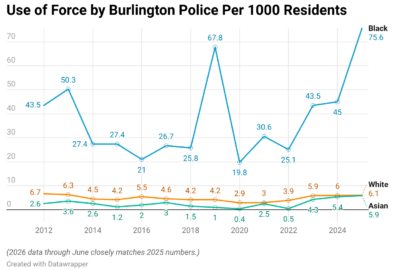
At the same time Burlington is considering expanding its public-safety and enforcement capacity, police use of force against Black people has reached its highest recorded level in the available data series.
In 2025, Black people were involved in 99 Burlington Police use-of-force person-incidents—the highest number recorded since 2012. Black people accounted for approximately 28 percent of people subjected to force while representing less than five percent of Burlington’s population. And even when police interactions rather than population are used as the comparison, Black people were subjected to force at nearly three times the rate of White people.
Those numbers cannot be relegated to the margins of tomorrow’s Burlington Forward conversation.
They must be at its center.
Burlington Has Been Here Before
This City did not discover racial disparities in policing in 2026.
For years, Black Burlingtonians and the Vermont Racial Justice Alliance have raised these concerns with City officials.
The City itself has repeatedly documented them.
In 2020 Burlington adopted the Racial Justice Through Economic and Criminal Justice Resolution. Burlington declared Racism a Public Health Emergency. The City engaged with Operation Phoenix R.I.S.E. It subsequently developed a Racial Equity Strategic Roadmap.
The Talitha community process called attention to basic needs, equity and belonging, mental-health services, healthier relationships between police and community, and civilian oversight.
The CNA assessment and review documented racial disparities in traffic stops and use of force, deficiencies in training, weaknesses in complaint and data systems, and the need for stronger accountability and alternative responses.
The City undertook reparations work.
It built REIB infrastructure.
It promised a transformation.
These were not isolated initiatives. Together, they reflected an understanding that Burlington had reached in 2020:
Public safety cannot be separated from racial justice, civil rights, housing, health, economic security, community power and equal protection.
Yet much of that work remains unfinished, fragmented, weakened, abandoned or never fully institutionalized.
And the racial disparities remain.
The Problem Is Bigger Than Burlington Forward
VRJA has engaged the Burlington Forward proposal seriously and constructively.
The current proposal is materially better than the original.
It now recognizes systemic inequities. It acknowledges unfinished racial-justice work. It contains stronger civil-rights and equal-protection language. It improves demographic reporting. It incorporates public-health and diversion strategies. The proposed Community Stabilization and Diversion Center has the potential to become a meaningful alternative to unnecessary arrest and emergency-department use if it is designed correctly.
We acknowledge those changes.
But improved language does not resolve the fundamental structural problem.
Burlington Forward still gives more operational force—authority, personnel, directives and implementation machinery—to downstream public-order and enforcement responses than Burlington has given to completing its unfinished racial-justice obligations.
That is especially dangerous when the City’s own data show that racial disparities are not merely historical.
They are happening now.
The disparity is particularly relevant because Burlington Forward concerns public spaces, disorder, trespass, enforcement and visible public-safety presence. Those are precisely the types of discretionary encounters in which the City’s racial data require careful examination.
Burlington cannot responsibly expand the machinery of enforcement without first confronting evidence that the existing machinery is producing profoundly disparate outcomes.
This Is Not a Democratic Problem or a Progressive Problem
It would be convenient for tomorrow’s debate to become another argument between political caucuses.
That cannot be the City’s answer.
The Democratic Council caucus proposed Burlington Forward. Its members therefore bear responsibility for ensuring that the resolution does not expand coercive governmental power faster than Burlington establishes protections against racial harm.
But responsibility does not stop there.
The Progressive Mayor and Progressive members of the Council have inherited—and now bear responsibility for—an unfinished body of racial-justice work. Persistent and worsening racial disparities in policing cannot simply be answered by opposing portions of Burlington Forward, objecting to its process, or criticizing its sponsors.
Where is the plan to address the racial disparity itself?
Where is the reconciliation of the CNA recommendations?
Where is the accounting for the Racial Equity Strategic Roadmap?
Where is the implementation status of the City’s 2020 Racial Justice Resolution?
Where is the current operational plan for Racism as a Public Health Emergency?
What became of the systemic framework embodied in Operation Phoenix R.I.S.E.?
What happened to the City’s commitments involving divestment and reinvestment, economic justice, cultural empowerment, Black home and land ownership, community investment, reparations and alternative public-safety infrastructure?
And most urgently:
What is Burlington going to do about the fact that Black people are being subjected to police force at extraordinarily disproportionate rates right now?
These questions belong to the Mayor and every member of the Burlington City Council.
Some current elected officials were not in office when these commitments were made.
That matters when assigning responsibility for the past.
It does not relieve anyone of responsibility for the present.
Past responsibility may be distributed. Present responsibility cannot be avoided.
We Are Not Asking Burlington to Choose Between Safety and Racial Justice
VRJA is not arguing that Burlington residents, workers, businesses or visitors should tolerate violence, threatening behavior or unsafe public spaces.
We are not arguing against accountability.
We are not arguing against treatment, recovery, behavioral-health intervention or effective responses to harmful conduct.
And we are not arguing that police have no legitimate role in public safety.
We are rejecting a false choice.
Burlington does not have to choose between public safety and racial justice.
It must provide both.
It does not have to choose between accountability and civil rights.
It must provide both.
It does not have to choose between addressing immediate crises and addressing the conditions that repeatedly produce those crises.
Responsible government must do both.
Before Burlington Moves Forward, Burlington Must Account for What It Left Behind
Before the Council adopts a new comprehensive public-safety framework, VRJA asks the Mayor and Council to commit to the following:
1. Reconcile the unfinished racial-justice work.
Within 60 days, publish a complete accounting of the City’s commitments under the 2020 Racial Justice Through Economic and Criminal Justice Resolution, Racism as a Public Health Emergency, Operation Phoenix R.I.S.E., the Racial Equity Strategic Roadmap, CNA recommendations, Talitha/community-engagement work, reparations commitments and related public-safety transformation.
For each commitment, tell the public what was completed, what was partially implemented, what was discontinued, what was never implemented, what was funded, what was not funded, what outcomes were achieved, and what remains to be done.
2. Address the policing disparity directly.
Commission an independent examination of racial disparities in police contacts, stops, citations, trespass actions, arrests, use of force, injuries, complaints and diversion outcomes, including review of the circumstances surrounding the 2025 use-of-force disparity.
The result must be a corrective-action plan, not simply another report documenting what Black Burlingtonians already know.
3. Do not allow enforcement expansion to outrun civil-rights accountability.
Major new sworn or contracted enforcement expansion under Burlington Forward should not occur before that independent review and corrective-action plan are publicly presented.
4. Establish racial-disparity corrective-action triggers.
If Burlington’s data demonstrate a material or persistent racial disparity in contacts, citations, trespass actions, arrests, force, injuries, complaints or diversion, City policy should require review, public explanation and corrective action.
Data collection alone is not accountability.
5. Complete the City’s public-safety transformation.
Reconcile the CNA recommendations, strengthen complaint and data systems, establish appropriate training, clearly define the roles of police and alternative responders, strengthen independent oversight and set measurable racial-disparity reduction objectives.
6. Give racial justice the same implementation power as enforcement.
If Burlington Forward contains deadlines, designated officials, resources and measurable outcomes for enforcement, then Burlington’s commitments involving racial health, housing, economic security, procurement, Black business development, home and land ownership, cultural empowerment, reparative work, youth opportunity and Black-led community infrastructure deserve the same institutional force.
Tomorrow’s Question Is Larger Than Burlington Forward
Tomorrow, Councilors will debate provisions of a resolution.
But the larger question facing the City is this:
What does Burlington do when its own institutions repeatedly document racial inequality, its government makes commitments to correct it, years pass, portions of that work disappear or remain unfinished, and the disparity becomes worse?
Surely the answer cannot be another acknowledgment.
Surely it cannot be another report.
And it cannot be to expand the governmental systems producing the disparity without simultaneously creating the machinery necessary to correct it.
In 2020, Burlington said racism was a public-health emergency.
An emergency does not cease to be an emergency because government stops talking about it.
Burlington said it would confront systemic racism.
A systemic problem cannot be answered with scattered programs.
Burlington said it would transform public safety.
Transformation cannot mean returning to greater reliance on the very systems that produced the demand for transformation while leaving the promised alternative infrastructure unfinished.
And Burlington said Black lives matter.
The measure of that declaration was never going to be what the City said in 2020.
The measure is what the City does when the data confront it in 2026.
Mayor Mulvaney-Stanak and members of the City Council, this responsibility now belongs to all of you.
Do not allow tomorrow’s meeting to become a contest between Democrats and Progressives.
Do not allow disagreement over Burlington Forward to obscure the larger failure.
And do not ask Burlington’s Black community to accept another public-safety framework without confronting what Burlington’s own data are telling you about our experience of public safety.
Before Burlington moves forward, Burlington must finish the work it left behind.
We are asking the Mayor and the entire City Council to own that responsibility together—and to act.
Vermont Racial Justice Alliance
The Legacy of Slavery Made Civil Rights Necessary. Civil Rights Made Democracy Possible.